


Pop Artists Are Glorified TikTok Influencers Now

The year is 2010, and Lady Gaga is fresh off the release of The Fame Monster (2009), which replaced her debut record The Fame (2008) at No. 1 on Billboard’s Dance/Electronic Albums chart. She steps onto the MTV Video Music Awards red carpet covered head to toe in raw beef. The rest is history.
Lady Gaga has always been an artist who can disrupt culture and create conversation. She never had to force people to pay attention to her, they were naturally enthralled by her endlessly shocking and controversial persona early in her career. What happens when culture is so divided that everyone no longer pays attention to the same thing? Artists are left scrambling to recapture their former glory through the seemingly last universal media outlet, TikTok.
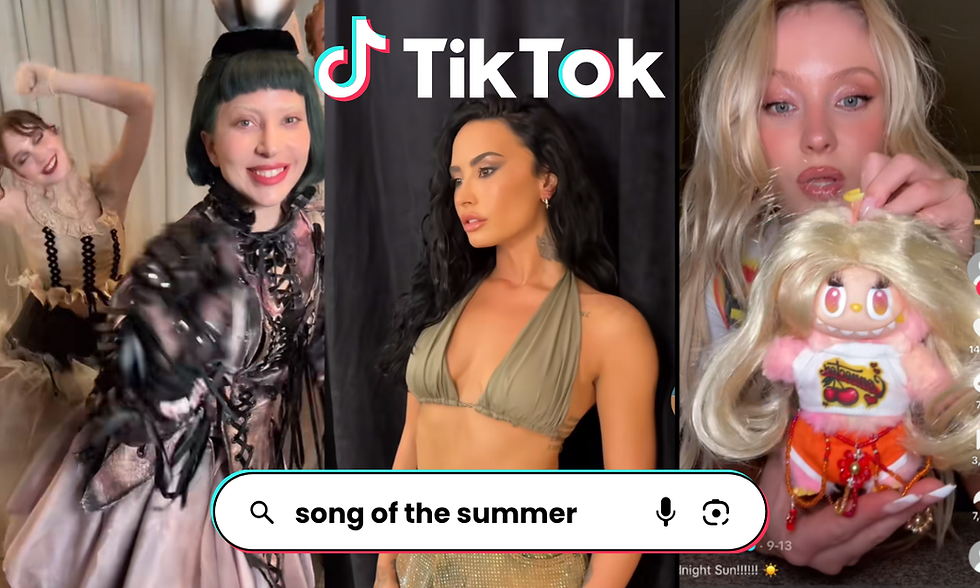
TikTok influencers like Addison Rae, Bella Poarch, and Brittney Broski, participants in dance trends or pop culture commentary, are reaching for a higher level of notoriety by releasing music. The opposite side of that coin is seasoned music veterans who are being forced by their record labels to make viral TikToks. As of Sept. 30, 2025, eight of Lady Gaga’s 10 most recent TikToks feature her performing the choreography for her latest release, “The Dead Dance.” The move is clearly designed to recreate the viral magic of hits like Charli XCX’s “Apple” or Doja Cat’s “Say So,” both of which exploded on the app thanks to fan-led dance trends. The track debuted at No. 40 on the Billboard Hot 100 before seeing a drop after three weeks to No. 60. The most popular video of the song, a dance video posted by Gaga herself, has 7.8 million views on TikTok.
Another artist who has seen a lot of online press recently is Demi Lovato. She announced her brand new album, ITS NOT THAT DEEP, joined the Jonas Brothers onstage for a performance of “This is Me,” and revealed her role as executive producer for the long-awaited Camp Rock 3. She broke the internet with her TikTok backstage at the Jonas Brothers show, garnering 8.9 million views. The video featured the first single off her new album, “Fast.” Despite Demi being the name on everyone’s lips, the track failed to chart on the Billboard Hot 100. In fact, Demi’s personality has gone more viral than her music. Some of the most popular videos on her TikTok page actually don’t feature her music at all. Two of her recent viral videos are her singing the iconic ending riff of “Defying Gravity” from Wicked (10.4 million views) and a recreation of a Camp Rock scene featuring Joe Jonas (17 million views).
What works for artists is one thing they can't control, outrage. Take Benson Boone and Sabrina Carpenter, two of 2025’s biggest hit makers. They both went viral during tour performances, Boone for his incessant backflipping and Carpenter for her suggestive poses during song “Juno.” These moments were not captured and posted by the artist, but by the audience. Carpenter specifically capitalized on this moment by changing her poses during the song every night of the tour, giving fans something to look forward to and critics something to write think pieces about. Boone went under a different kind of fire, being criticized as a one-hit wonder and an industry plant. He later created a music video for his album's second single, "Mr. Electric Blue," using these criticisms as punchlines, fostering even more conversation online about how he’s “clapping back” against the haters.
In an online culture where consumers are trained to go on social media and experience extreme emotions within seconds, the best way to break through the noise is to create outrage. The more discourse created, the more people are talking about and henceforth promoting your work. This strategy blatantly worked for Sabrina Carpenter when her new album cover for Man’s Best Friend (2025) sparked massive controversy and conversation, garnering an opinion from every person on the internet. Yet, it didn’t stop people from listening to the album. Man’s Best Friend went on to earn the No. 1 spot on the Billboard 200, with 366,000 equivalent album units earned in its first week, outselling her previous record.
Still, there’s hope for the industry since It’s clear not every artist wants to participate in a TikTok-focused culture, and some are speaking out. Singer-songwriter Halsey criticized her label in 2022 in a now-deleted TikTok video saying, “I’ve been in this industry for eight years and I’ve sold over 165 million records and my record company is saying I can’t release [a new song] unless they can fake a viral moment on TikTok.” Another artist, Florence Welch of Florence + The Machine, posted a video of herself singing with the caption, “The label are begging me for 'low fi tik toks' so here you go. pls send help.” The more artists that can bring awareness to issues of the industry, the less normalized it can become to create algorithm-fodder music.
When artists are forced to make videos featuring their songs, the artistic integrity of the music is diluted. The intention behind creating becomes what will go viral instead of what will creatively invigorate not only the musician, but the audience hearing it. Songs are getting shorter to match shrinking online attention spans, and traditional song structures are increasingly abandoned in favor of viral “moments.” Making these embarrassing videos only dilutes the mystique of an artist’s brand. The most successful longstanding chart artists, like Taylor Swift or Beyoncé, don’t create TikToks that make them seem accessible to fans. They build an arms length of separation creating interest in the music rather than their online presence. The difference between Sabrina Carpenter and Demi Lovato making a funny TikTok is that Carpenter uses her online presence as an extra way to connect with her fans while Lovato needs videos to go viral in order to make headlines.
As the dystopian nature of social media continues to shape every aspect of society, the music landscape continues to evolve into a less complex, more algorithmic and commercialized form. When viral TikToks become more important to labels than the integrity and quality of the work their artists can create, the point is truly lost.


Comments